The Compass That Awakened Einstein
March 14 is a remarkable day for lovers of science and imagination.
It is the birthday of Albert Einstein, born in 1879. It is also celebrated around the world as Pi Day, honoring the mathematical constant π (3.14), the number that describes the relationship between the circumference of a circle and its diameter.
The digits of π go on forever. They never repeat and never end.
In many ways, π represents infinity — an endless unfolding of numbers, patterns, and mysteries.
It feels wonderfully fitting that Einstein, the man who transformed our understanding of the universe, was born on the very day that celebrates infinity.
Yet Einstein’s journey did not begin with equations.
It began with a childhood moment of wonder.
A Boy and a Compass
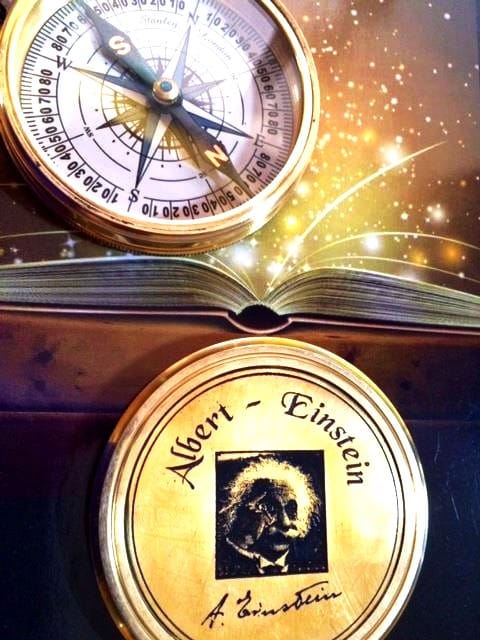
When Albert Einstein was about five years old, his father Hermann showed him a small magnetic compass.
The young boy turned the instrument over in his hands, puzzled and fascinated. No matter how he moved the compass, the needle always pointed north.
Something invisible was guiding it.
Einstein later said that this experience made a deep and lasting impression on him. It was the moment he realized that unseen forces exist in the universe—forces that cannot be touched but are undeniably real.
That tiny compass awakened a curiosity that would shape his entire life.
The Inspiration Behind Einstein’s Compass
Years later, as I studied Einstein’s early life while writing fiction, I kept returning to that moment.
A young boy.
A mysterious compass.
An invisible force guiding the needle.
And like every storyteller, I began to ask a simple question:
What if?
What if the compass Einstein held as a child was more than a scientific instrument?
What if it carried a deeper mystery—something ancient, something connected to a forgotten world?
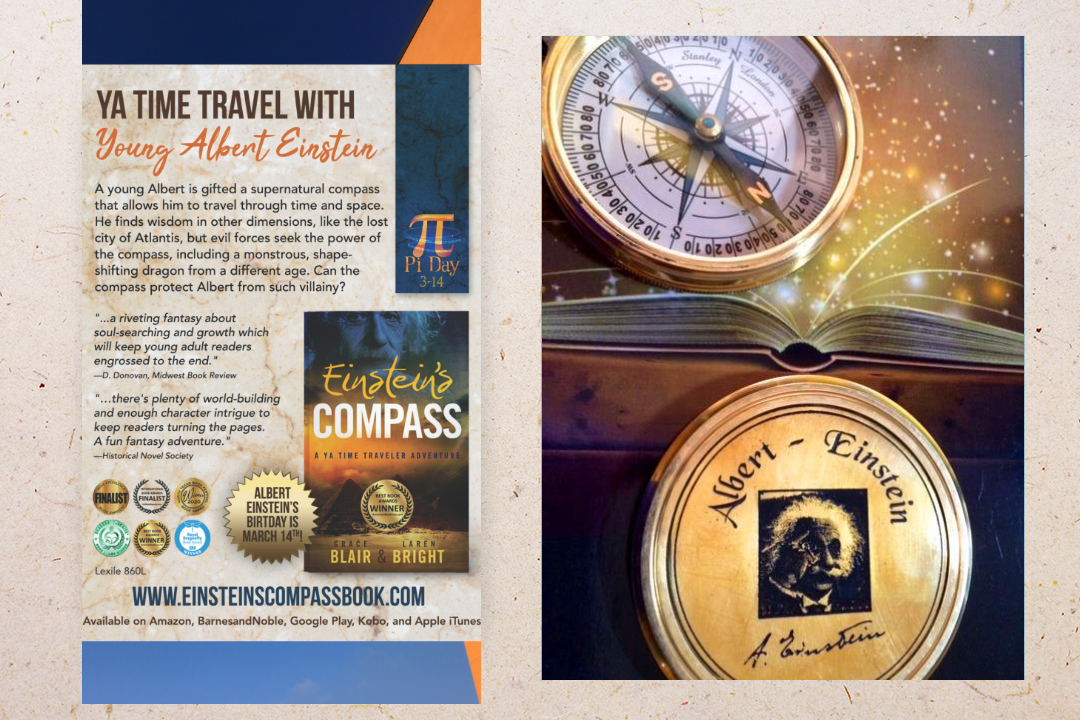
That question became the seed of my novel Einstein's Compass: A YA Time Traveler Adventure.
In the story, the compass becomes a gateway to a much larger mystery—one that connects young Albert Einstein to the lost civilization of Atlantis and to secrets about time itself.
What if Einstein’s revolutionary ideas about space and time were not simply inventions?
What if they were echoes of knowledge from another age?
In Einstein’s Compass, Albert’s curiosity leads him on a journey through hidden history, ancient wisdom, and the timeless struggle between light and darkness.
The Spirit of Pi Day
Pi Day reminds us that the universe is filled with beautiful patterns.
Circles appear everywhere in nature—from the orbits of planets to the spirals of galaxies.
The number π describes those circles mathematically, yet its digits continue forever.
Like curiosity, it has no end.
Einstein once said:
“The important thing is not to stop questioning. Curiosity has its own reason for existing.”
That spirit of curiosity is what connects science and storytelling.
Both begin with wonder.
Both begin with the courage to ask questions no one has asked before.
A Birthday Wish for Curious Minds
Today, as we celebrate Einstein’s birthday and Pi Day, we celebrate something even greater:
The power of curiosity.
Every discovery begins with a question.
Every great story begins with imagination.
Perhaps somewhere today a child will pick up a compass, look up at the stars, or open a book and feel that same spark Einstein felt as a boy.
And perhaps that spark will lead to discoveries—or stories—that change the world.
Modern Mystic Media Blessing
May the compass of your curiosity always point toward discovery.
May the mysteries of the universe inspire you to keep asking “what if.”
And may the circle of imagination continue endlessly—like the digits of π.
Happy Birthday, Albert Einstein.
And Happy Pi Day to all who believe wonder has no limits.
— Grace Allison Blair
"Einstein's Compass a YA Time Traveler Adventure"