The Objects That Choose Us: Why Sacred Tools Appear When We’re Ready”
Here at Modern Mystic Media, we explore the quiet intersections where myth, science, and inner knowing meet.

Here at Modern Mystic Media, we explore the quiet intersections where myth, science, and inner knowing meet. These are the places where stories don’t just entertain—they remember. Today’s reflection is inspired by a question that has followed humanity across centuries and civilizations: Why do certain objects seem to arrive in our lives at exactly the right moment? What follows is not an answer, but an invitation.
There are moments in life when an object enters our path and quietly rearranges everything.
It isn’t always dramatic. Sometimes it’s small enough to fit in a child’s hand. Sometimes it’s dismissed as coincidence. Yet long after its arrival, we realize it marked a turning point—a beginning, a remembering.
Across myth, history, and personal experience, sacred tools appear not because we go searching for them, but because we are ready to receive them.
Sacred Objects in Story and Myth
Nearly every enduring story carries an object at its center.
The Holy Grail.
Excalibur.
The philosopher’s stone.
The ring.
The compass.
These objects are never merely props. They are thresholds—symbols of initiation. The hero does not wield them through strength alone, but through alignment. The object responds when the bearer has reached a particular state of readiness: morally, spiritually, or emotionally.
In ancient traditions, such tools were understood as living intelligences—responsive to consciousness rather than command.
Einstein’s Compass and the Awakening of Wonder
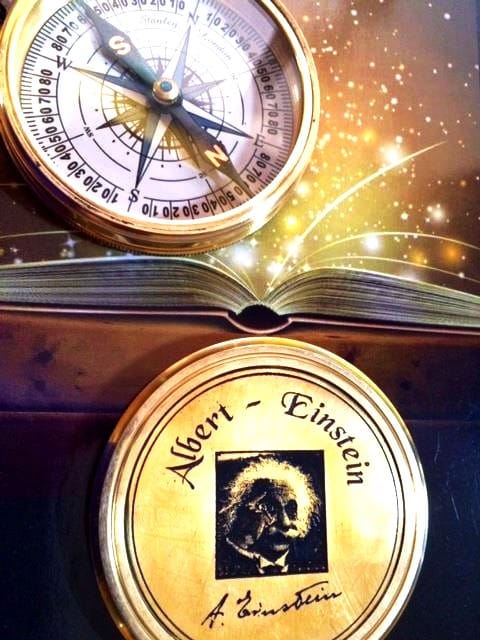
When Albert Einstein was about six years old, his father gave him a compass.
The needle’s unwavering pull toward north captivated him. Long after the moment passed, Einstein would describe this experience as his first encounter with something profoundly mysterious—an invisible order shaping the visible world.
That small compass did not make him a scientist.
It awakened him as a seeker.
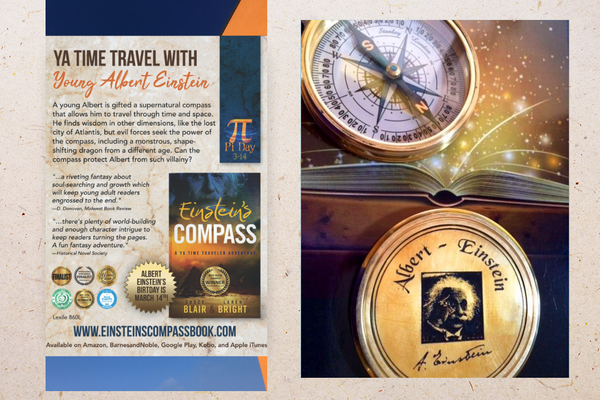
In Einstein’s Compass, I reimagined this moment not as an accident of childhood curiosity, but as a quiet calling. The compass becomes a symbolic bridge between the material and the unseen—a reminder that unseen forces govern far more than we are taught to notice.
The Shamir: A Tool That Answered to Spirit
In ancient Hebrew lore, King Solomon is said to have used the Shamir—a supernatural substance or force—to cut stone for the Temple without violence or metal tools. Moses, too, is said to have summoned the Shamir to inscribe the Ten Commandments.
What is remarkable is not the power of the Shamir, but its conditions. It could not be controlled by force. It responded only to wisdom, restraint, and spiritual authority.
In other words, the Shamir was not used.
It was invited.
Why These Objects Appear When They Do
Sacred tools appear at moments of transition:
- When certainty dissolves
- When identity is shifting
- When logic alone no longer satisfies
They arrive not to give answers, but to activate perception.
Psychologically, we might call this projection or symbolic meaning-making. Spiritually, we might call it remembrance. Mythically, we understand it as initiation.
Whatever the language, the pattern remains the same:
The object reflects something already awakening within us.
Modern Sacred Tools Still Find Us
Today, sacred tools rarely arrive wrapped in mythic language.
They might appear as:
- A book encountered at the exact right moment
- An inherited object that suddenly feels alive
- A creative idea that refuses to leave
- A question that becomes a compass
We often underestimate these moments because they feel ordinary. But transformation rarely announces itself loudly.
It whispers.
Listening for the Call
Not every object is sacred—but every sacred object calls for listening.
The question is not What power does this hold?
The question is What is awakening in me?
In my stories, objects glow, hum, and respond. In life, they do something quieter but no less powerful: they reorient us. They remind us of that mystery still participates in our becoming.
And sometimes, when we are finally still enough to notice, we realize the object did not choose us by chance at all.
It arrived because we were ready.
If you find yourself thinking of an object as you read—something small, ordinary, or long forgotten—pause with it for a moment.
Not to analyze.
Not to explain.
Only to listen.
Sacred tools do not demand belief. They ask for presence.
May you recognize the quiet guides already walking beside you.
May wonder return where certainty once ruled.
And may whatever is finding its way toward you arrive gently—exactly when you are ready.
Author’s Note
I was drawn to this topic because certain objects have quietly shaped my own journey—appearing not when I was searching, but when I was listening.
While writing Einstein’s Compass, I kept returning to the idea that transformation rarely arrives with spectacle. More often, it enters softly: through a symbol, a question, or a small moment that refuses to be dismissed. The compass in Einstein’s hand, the Shamir in ancient lore—these were not tools of power, but of perception.
This reflection is my way of honoring those quiet guides. The ones that don’t demand belief, only presence. And the ones that seem to find us precisely when we are ready to remember something we already know.
— Grace Allison Blair
Einstein's Compass Audio Book Clip